IGBT's role is to act as an inverter that converts direct current into alternating current.
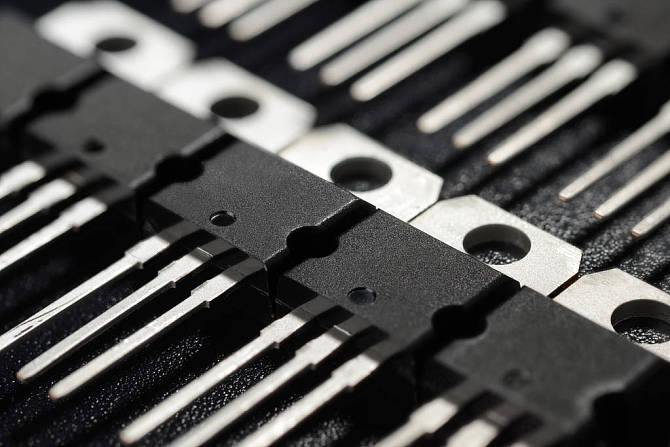
IGBT is a type of power transistor that is widely used in intelligent power grids, aerospace, new energy vehicles, telecommunications, power electronics, induction heating and other fields. It is an important component in power electronics technology.
IGBT has high input impedance, low conduction voltage drop, low switching loss, fast turn-off, high reliability, and long service life.
1. Drive circuit: Due to the trade-off between UCE (sat) and
short-circuit tolerance of IGBT, it is recommended to select the gate
voltage as +UG=15V±10%,—UG
=5~10V. The gate resistance is closely related to the turn-on and
turn-off characteristics of the IGBT. The RG hour switching loss is
reduced, the switching time is shortened, and the turn-off pulse voltage
is increased. The appropriate RG value should be chosen based on the
best compromise between surge voltage and switching loss (frequency
dependent), typically chosen to be 10~27Ω. To prevent the gate from
opening, connect a 20~30kΩ resistor in parallel with the emitter and
emitter.
2. Protection circuit: When the IGBT module is used at high frequency,
the wiring inductance is prone to spike voltage, and attention must be
paid to the wiring inductance and component configuration. The
protection items should be: over current protection, over voltage
protection, gate overvoltage and undervoltage protection, safe working
area, overheat protection.
3. Absorption circuit: Since the IGBT switching speed is fast, it is
easy to generate surge voltage, so a surge clamp circuit must be
provided.
4. When the IGBTs are used in parallel, the wiring of the gate circuit,
the current imbalance, and the temperature imbalance between the
devices should be considered.